
Stanza Extravaganza: improving Latin American Spanish morphological classifiers
- 18.6%
- clitic verbs Stanza missed before preprocessing
- 100%
- of those recovered after clitic separation
- 2
- dialects: Paraguayan and Argentine Spanish
- 1st
- in Linguistics, UURAF 2024
Language acquisition research runs on transcripts: child speech and child-directed speech, tagged for parts of speech and morphology. Tagging by hand does not scale, and the statistical taggers that do scale were trained mostly on English and European Spanish. This poster asks how much a Latin American corpus loses to that mismatch, and whether a small amount of linguistic knowledge can buy it back.
The problem
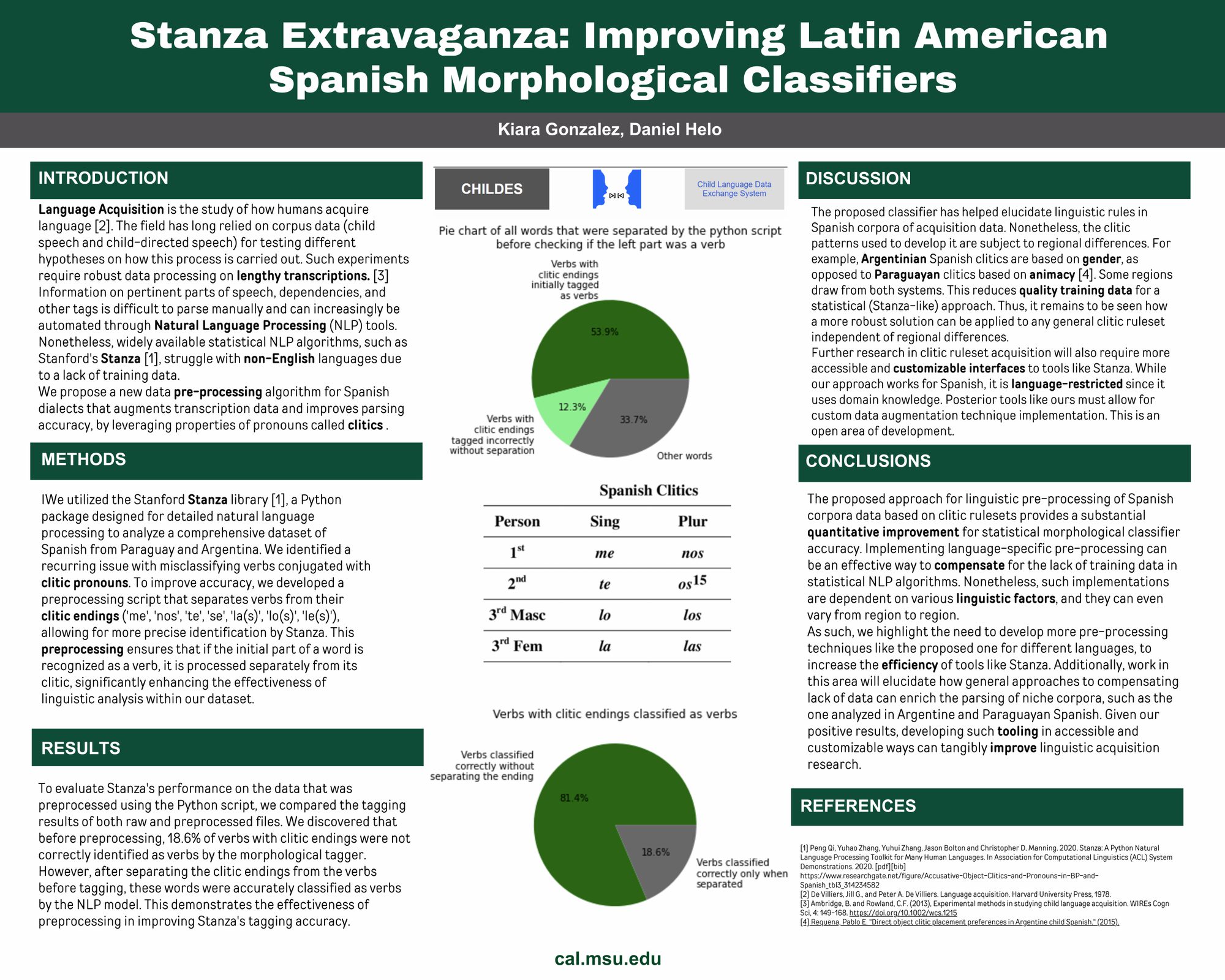
Spanish attaches clitic pronouns to verbs: dámelo, sentate, vamos a verlos. Stanza’s Spanish pipeline frequently fails to recognise such forms as verbs at all. On the lab’s Paraguayan and Argentine acquisition data, 18.6% of verbs with clitic endings were not tagged as verbs.
The fix
A preprocessing script separates a candidate verb from its clitic ending (me, nos, te, se, lo(s), la(s), le(s)) before tagging, and passes the two pieces to Stanza only when the stem is itself a plausible verb. After preprocessing, every verb in that 18.6% was classified correctly. The pass is cheap, deterministic, and leaves the rest of the pipeline untouched.
What it does not solve
Clitic systems vary by region. Argentine clitics pattern by gender, Paraguayan by animacy, and some regions mix both. A rule set tuned to one dialect is not automatically right for another, which limits how far a single preprocessing pass can travel. The honest conclusion is that language-specific preprocessing is an effective way to compensate for thin training data, and that more of it is needed, per language and per region.
Why it matters
Tools optimised for other Spanish variants have been the default for researchers studying acquisition in Latin American communities. Closing that gap, even one clitic rule at a time, widens who gets to do corpus work at all.